
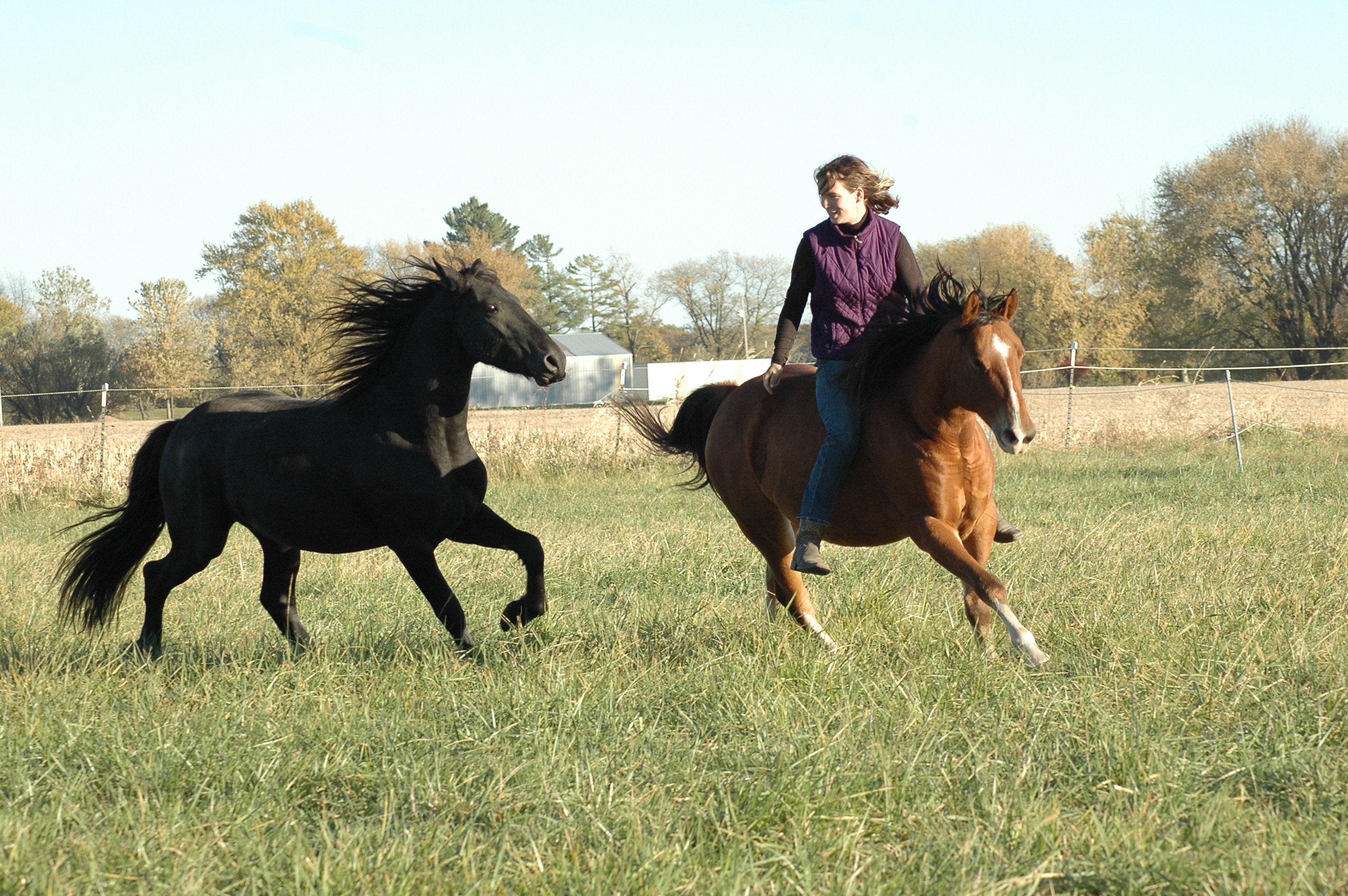
There’s a moment that happens when you start riding bridleless around other people.
No one says anything at first. They just watch. And in that watching, you start to see how deeply the idea of control runs in the horse world.
Some riders around you are riding in halters, bosals, snaffles, leverage bits. Many of them ride well. Their horses are soft, responsive, connected. Others have three or four different tools stacked from the shoulders up, claiming they need every one of them to “stay in control.”
And those are often the same people who look at bridleless riding and say,
“You have no control.”
“That’s dangerous.”
I don’t say much. I just watch. And over time, patterns start to show themselves.
Because here’s the part that’s hard to ignore once you see it.
Horses spook or take off in moments we’ve all seen. One rider brings their horse back quietly with a simple setup. Another regains rhythm with a bit and soft hands. And then there’s a rider with even more equipment involved who still can’t quite reach their horse.
It isn’t black and white. We’ve all been on different sides of that moment. But once you start paying attention, it becomes harder to believe that control is something we actually possess.
At some point, you have to ask the uncomfortable question:
Are we actually controlling the horse?
Or are we convincing ourselves that we are?
I’m not saying bridleless riding is safer than a bit. I’m not saying everyone should do it. I’m not suggesting anyone drop the bridle and hope for the best. Done incorrectly, it can be dangerous, just like anything done without preparation, understanding, or feel.
What I am saying is this: danger doesn’t come from the absence of a tool. It comes from the absence of communication, trust, and understanding.
A bit does not create control.
A halter does not create control.
More equipment can create a feeling of certainty, but it doesn’t guarantee clarity, communication, or control.
Because at the end of the day, we’re still sitting on a twelve-hundred-pound animal with a mind of their own.
Control promises safety. It promises certainty. It tells us that if we do enough, hold enough, manage enough, nothing will go wrong.
And yet, things still go wrong.
Horses still spook.
They still rush.
They still resist.
They still have off days.
They get sore. They get excited. They have moments where their bodies or minds feel different than they did yesterday.
I’ve had moments where I was doing everything “right.” Consistent work. Structured sessions. Always learning. And the horse was still tight. Still guarded. Still mentally somewhere else. Not because they were wrong or resistant, but because what I was asking didn’t match what they needed in that moment.
That realization didn’t come all at once. It crept in quietly.
It showed up when I noticed that the horses who felt the safest weren’t the most restricted. They were the ones who understood their job. The ones who trusted the response they would get from me. The ones who didn’t feel the need to brace against what I might do next.
Control tries to prevent behavior.
Responsibility teaches the horse how to respond.
That difference matters.
Control relies on restriction. Responsibility relies on understanding.
Control feels strong until pressure shows up. Responsibility holds when things go wrong.
Letting go of control doesn’t mean letting the horse do whatever they want. It doesn’t mean chaos. It doesn’t mean a lack of boundaries. And it absolutely does not mean ignoring behavior that needs to be addressed.
You don’t need control to have boundaries.
You don’t need control to have respect.
You don’t need control to correct unsafe or inappropriate behavior.
What you need is clarity.
Consistency.
Fair follow-through.
And the ability to regulate yourself before asking the horse to regulate themselves.
I saw this most clearly with Onyx.
He is young. Green. When he had around twenty rides or less, none of them particularly consistent, I rode him bridleless for the first time. There wasn’t a plan behind it. It wasn’t something I had mapped out or decided ahead of time. It just felt natural in that moment, like checking in.
What struck me later was that, before I ever stepped on, the idea itself hadn’t felt unusual. Not because it was something we did often, and not because I was trying to make a point, but because bridleless didn’t feel separate from the conversation. It was simply another way of listening.
That moment didn’t turn into a rule or a routine. It just stayed with me.
Sometimes I come back to it, not to test anything, but to feel where our communication is that day. No agenda. No expectation. Just the two of us moving together, listening, and staying connected without anything sitting between us.
What surprised me wasn’t that he stayed with me.
It was how settled he felt. How attentive. How present.
Not perfect.
Not polished.
But honest.
Those moments weren’t about showing anything. They were about our connection and our communication. About how clearly we could hear the conversation, and whether we could stay with each other without something holding it together for us. It was about partnership. About moving as a team.
And honestly, it was freeing.
That didn’t mean I suddenly rode him bridleless all the time. It didn’t mean he was “finished.” It didn’t mean there weren’t still boundaries, corrections, or expectations. It simply showed me something important.
When understanding is there, the idea of control never really enters the picture.
The hardest part of letting go of control isn’t the horse.
It’s us.
Control feels safe because it gives us something solid to hold onto. Responsibility feels vulnerable because it asks us to trust what we’ve built together. It asks us to trust our horses with our bodies, our balance, and sometimes our lives, whether that’s crossing water, dragging cattle, jumping big fences, or navigating the unexpected.
Once I accepted that I never truly had control in the first place, something shifted. Not easier. That’s not the right word. But clearer. Lighter. More honest.
My horses didn’t become less connected when I stopped measuring our work through the idea of control.
They became softer.
More willing.
More present.
Because true connection doesn’t come from restraint.
It comes from understanding.
And that’s a much stronger place to stand.
– Southside Performance Horses
Photography By: Lucy Broadwater